Brickwork
Why Garden Walls Lean, Patios Sink, and Driveways Crack Across Kent: A Bricklayer’s Honest Guide to What Goes On Underneath
Most failed patios, leaning boundary walls, and sunken driveways in Kent fail for the exact same reason: whoever built them cheated on the groundworks underneath. Here is a straightforward, on-the-tools guide to Kent’s tricky soils, local council rules, and how to build outdoor spaces that actually stay put.
Spend fifteen years digging footings and laying bricks across all thirteen districts of Kent, and you start to notice a pattern. Almost every week, we get called out to look at a garden wall that has developed a dangerous lean toward the pavement, a two-year-old porcelain patio where the slabs are rocking and popping loose, or a block-paved driveway with twin wheel ruts deep enough to hold a puddle until July.
Homeowners usually blame the bricks, the slabs, or the weather. Nine times out of ten, the materials on top had nothing to do with it. The job failed because whoever priced it cut corners on the bit you can’t see once the skip leaves the drive: what goes on underneath.
At Truly Brickwork & Construction, we work out of Rochester and cover the whole county, from tight Victorian terraces in Medway and Gravesham down to rural plots in Ashford and coastal homes in Thanet. If there is one thing Kent teaches you quickly, it is that you cannot use a one-size-fits-all footing when the ground beneath your boots changes completely every ten miles.
Whether you are planning a new garden build or trying to figure out why an existing one is giving way, here is an honest, on-the-tools look at how Kent’s ground behaves, the shortcuts to watch out for, and how to get the job done properly the first time.
1. Kent’s Ground Conditions: Why a Footing in Thanet Fails in Maidstone
When you hire a builder who doesn't understand local groundworks, they dig the same shallow trench regardless of the postcode. In Kent, that is a recipe for movement. Depending on where you live, our digger buckets hit one of five very different types of ground:
- Swelling Weald Clay and London Clay (Maidstone, Ashford, Tonbridge & Malling, Sevenoaks): Heavy clay acts like a giant sponge. In a wet winter, it holds water and swells up; during a dry August, especially if there are mature oak, willow, or poplar trees nearby, it shrinks back and cracks. If a shallow patio sub-base or wall footing sits in that top seasonal movement zone, it will heave up in winter and drop in summer. Dealing with weald clay foundation depth for extensions or heavy garden walls means digging past the dry crust—often down a metre or more—down to stable clay that stays at a constant moisture level year-round.
- Hard Flinty Chalk (Thanet, Dover, North Downs, Medway Valley slopes): Digging into chalk around Ramsgate, Dover, or up on the Downs above Rochester is hard work on the teeth of an excavator bucket, as it is packed with sharp flint nodules. Chalk drains well and takes weight brilliantly once you are below the frost line, but the top layer can turn to a pasty slurry if it gets churned up in the rain during winter groundworks.
- Greensand Ridge & Sandy Loams (Sevenoaks, Westerham, Maidstone fringes): Greensand is much kinder to dig, but sandy soils can wash out if rainwater from a roof downpipe or a sloped driveway is allowed to channel underneath a sub-base without proper kerbing and drainage.
- Wet Marsh Alluvium (Swale, Wantsum Channel, Hoo Peninsula, Romney Marsh): Low-lying silts and soft marsh ground have very little natural bearing strength. If you lay a heavy driveway or build a brick wall here without a woven geotextile membrane and a thickened, well-compacted MOT Type 1 stone base, the sub-base simply punches down into the soft silt over time.
2. Leaning Boundary Walls, Spalling Bricks, and the Cement Trap
One of the most common emergency calls we get is for leaning garden wall repair rochesterand across the older parts of Medway, Canterbury, and Tunbridge Wells. Usually, a front boundary wall or a pier by the driveway gate has started tilting outward, or a long horizontal crack has opened up along a bed joint a few courses above the ground.
Why Garden Walls Start to Lean
There are three main culprits behind a leaning brick wall:
- Shallow or non-existent footings: Many Victorian and 1930s garden walls were built straight onto a shallow bed of lime concrete or stepped brick footings just 200mm below the soil. Years of tree roots, next door’s raised flowerbed pushing from behind, or heavy traffic vibration eventually tip them off plumb.
- Building single-skin walls too high: A single-skin brick wall (half-brick thick, around 102mm) has very little strength against wind gusts unless it has sturdy brick piers bonded in every 1.8 to 2.4 metres. Anything over knee height really wants to be a full one-brick-thick wall (215mm) laid in Flemish or English bond, or a cavity/block-backed wall if it is holding back soil.
- Trapped water behind the wall: When a garden sits higher than the pavement or patio, wet soil presses against the back of the brickwork. Without a perforated land drain wrapped in membrane, clean shingle backfill, and weep vents at the base, that water weight will push even a thick wall over.
If you are trying to turn a steep, unusable lawn into flat levels, cutting corners on the masonry is fatal. When we build sloping garden retaining walls kent homeowners can actually trust for decades, we treat them like small civil engineering jobs—using reinforced concrete foundations, hollow blockwork cores filled with concrete and steel rebar where height demands it, tanking membranes on the earth side, and proper weep holes so winter rain never builds up behind the face brick.
Why Hard Cement Ruins Old Bricks, Flint, and Ragstone
If you own a period cottage, an older Victorian terrace, or a property with traditional boundary walls, never let anyone repoint your brickwork with a strong, dark-grey sand-and-cement mix.
Soft red imperial bricks, traditional brick and flint wall repair kent projects, and kentish ragstone wall restoration maidstone jobs (which we see all the time around Loose, Barming, and the Malling villages) need to breathe. Old walls were built with lime mortar, which acts like a wick—drawing damp out of the wall and letting it evaporate harmlessly through the mortar joints.
When someone smears hard Portland cement over those joints, moisture gets trapped inside the softer brick or ragstone. The first hard frost of January freezes that trapped water, expands it, and pops the front face clean off the brick (spalling). Specialising in proper lime mortar repointing kent wide means raking out failed joints carefully without slicing into the arris of the bricks, blending Natural Hydraulic Lime (NHL 3.5) with sharp, well-graded sands, and churning out a breathable joint that flexes with the wall and protects the masonry for another fifty years.
Quick Check: UK Rules on Garden Wall Heights & Party Walls
How high can I build a garden wall without planning permission in Kent? Under UK Permitted Development rules, a garden wall or fence next to a highway used by vehicles (or the footpath running alongside it) can be up to 1 metre high without planning permission. Elsewhere on your boundary (such as between rear gardens), you can build up to 2 metres high. However, if you live in a Conservation Area (common in Rochester, Canterbury, Sandwich, and Tunbridge Wells) or a Listed Building, check with your local council first. Also, if you are digging new foundations on a shared boundary line or rebuilding a shared brick wall (a "party fence wall"), you may need to serve a notice under the party wall act garden boundary walls rules before starting work.
3. Why Porcelain Patios Crack or Come Loose (And How to Lay Them Properly)
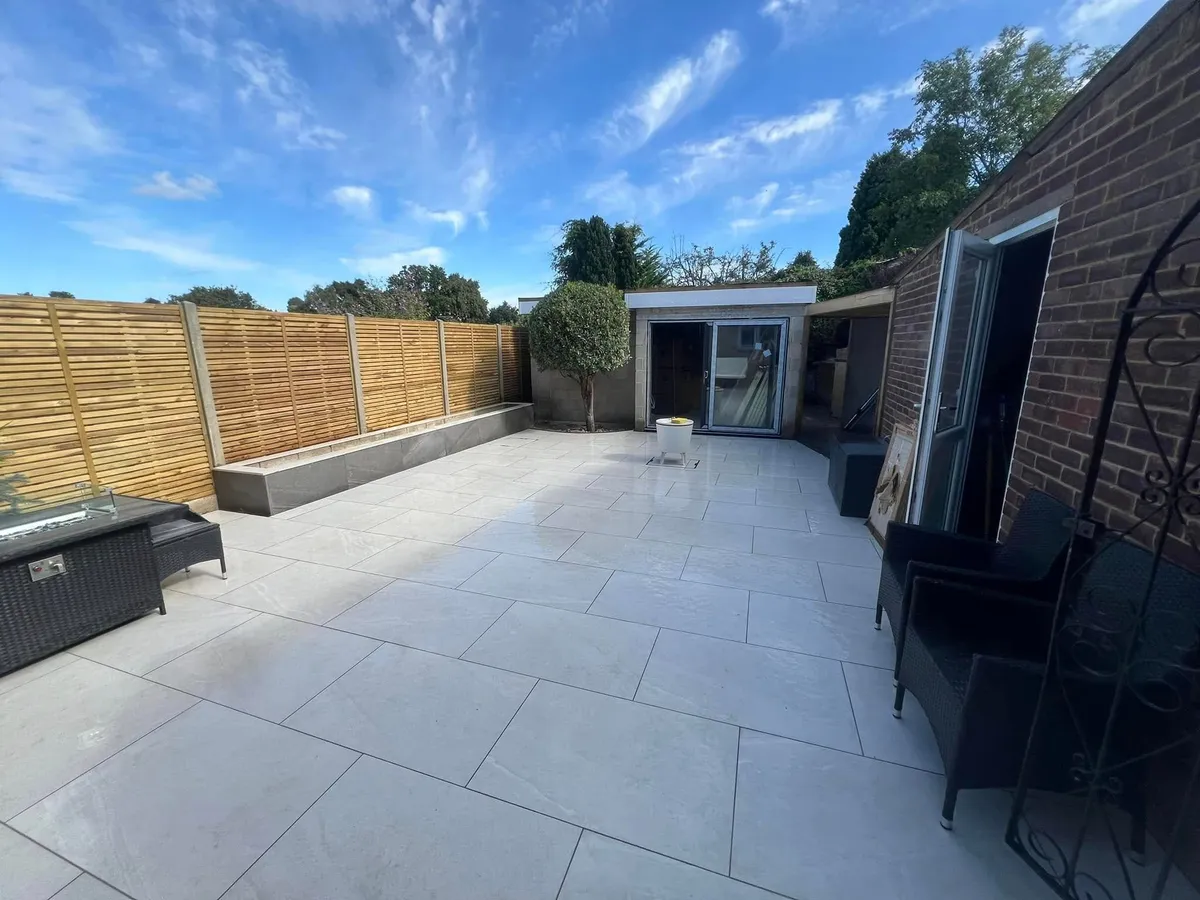
Over the last few years, vitrified porcelain has overtaken riven Indian sandstone as the most requested paving material across Kent. When people ask us to weigh up indian sandstone vs porcelain patio kent options, the answer is straightforward: Indian sandstone gives you warmth, natural colour variation, and a traditional cottage feel, whereas porcelain is non-porous, shrugs off green algae, and wipes clean after a barbecue without needing sealing.
But porcelain is also completely unforgiving if the installer treats it like an old concrete council slab. Nearly every failed porcelain patio we get asked to rip up and relay suffered from one of three shortcuts:
[ SHORTCUT 1: Spot-Bedding ("Dot and Dab") ]
- What cowboys do: Drop five blobs of mortar under each slab and tap it down because it is fast and saves mixing barrows of grit sand.
- What happens next: Hollow pockets sit underneath the tile. Walk on a corner, drop a heavy garden planter, or wait for winter water to collect in those gaps and freeze, and the tile snaps or starts rocking like a loose tooth.
- The proper method: Every single slab must be laid on full bed porcelain paving kent specifications—a continuous, wet, workable 4:1 sharp sand and cement bed laid over at least 100mm to 150mm of mechanically compacted MOT Type 1 crushed stone.
[ SHORTCUT 2: Skipping the Slurry Primer ]
- What cowboys do: Lay porcelain straight onto wet sand and cement with nothing painted on the back of the tile.
- What happens next: Because vitrified porcelain absorbs less than 0.5% water, ordinary cement mortar cannot grip its smooth underside. Within six to twelve months, the tiles completely debond from the mortar bed—you can literally lift them up with your fingers.
- The proper method: Every slab must have a polymer-modified SBR bond bridge (slurry primer) brushed evenly onto the back immediately before it goes down onto the wet mortar bed, locking the tile and the bed into a single solid unit.
[ SHORTCUT 3: Bridging the Damp Proof Course (DPC) ]
- What cowboys do: Lay the new patio straight over the old flags to save on skip hire and muck-away, bringing the finished paving level right up to—or above—the house’s damp proof course.
- What happens next: Rainwater splashes off the hard paving against the house wall above the DPC, causing internal damp along your skirting boards.
- The proper method: We always excavate properly so the finished patio sits at least 150mm (two brick courses) below the house DPC. Where a client wants a flush indoor-outdoor threshold for bi-fold doors, we fit a recessed ACO or stainless-steel linear slot drain along the threshold and tie it into proper patio drainage and soakaways on clay soil so surface water is taken away immediately.
Whether we are working as porcelain patio installers maidstone families call in to rescue a botched job, acting as raised patio and garden steps builders on a split-level plot in Sevenoaks, or building bespoke brick outdoor kitchen builders kent projects complete with rendered seating walls and porcelain worktops, the rule never changes: dig deep enough, compact the stone in layers with a heavy plate compactor, prime every tile, and get the water fall right (typically a 1:60 to 1:80 fall away from the house).
4. Driveways, SuDS Rules, and Dropped Kerbs Across KCC and Medway
A front driveway takes more punishment than any other surface on your property. Turning power-steering wheels on the spot, parked vans, and delivery lorries will quickly ruin a shallow sub-base.
When we price permeable block paving driveways medway or resin bound driveway sub base preparation across Kent, we start with the depth of the dig. For normal family cars on clay soil, we excavate at least 250mm to 300mm below finished level, lay a heavy-duty geotextile membrane so the clay below cannot pump up into the stone, and build up compacted layers of MOT Type 1 (or open-graded Type 3 stone for permeable setups). We also bed all perimeter kerbs and block edges onto a thick concrete haunch so the outer blocks can never spread sideways when a tyre turns near the edge.
The 5m² Front Garden Rule & Local Dropped Kerb Permits
Do I need planning permission to pave my front garden in Kent?Under UK law, if you are paving more than 5 square metres of a front garden, you do not need planning permission provided you use a permeable surface (such as permeable block paving, resin-bound gravel over a permeable base, or gravel grids) or if you angle the driveway so rainwater runs off into a lawn, flowerbed, or linear drainage channel connected to a soakaway on your own land. You only need planning permission if your new driveway sheds rainwater directly out onto the public pavement or road.
If you are opening up a front boundary wall to create a brand-new parking bay, remember that crossing the public footpath requires a formal vehicle crossover (dropped kerb) licence. As experienced dropped kerb and driveway contractors kent homeowners rely on, we regularly guide clients through how the county splits up:
- Medway Council handles dropped kerb applications if you live in Rochester, Strood, Chatham, Gillingham, or Rainham.
- Kent County Council (KCC) Highways handles applications across the other twelve Kent districts (including Maidstone, Dartford, Gravesham, Swale, Canterbury, and Ashford).
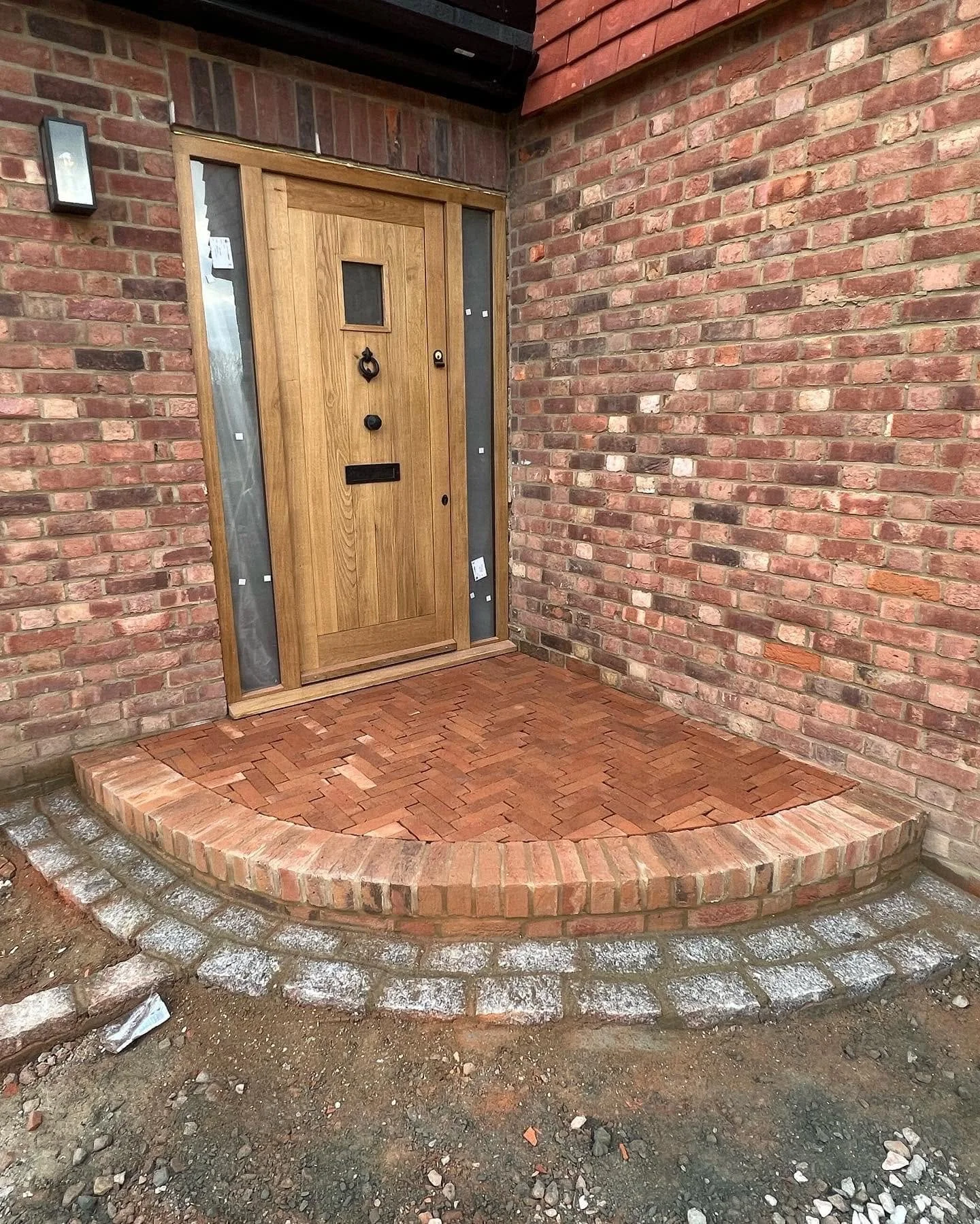
Often, homeowners get us to complete the front garden excavation, build the new brick entrance piers, lay the compliant driveway with its threshold drainage channel right up to the boundary line, and coordinate the final highway crossover apron so the whole front of the house comes together cleanly.
5. Extensions, Fencing, and Finishing the Garden Properly
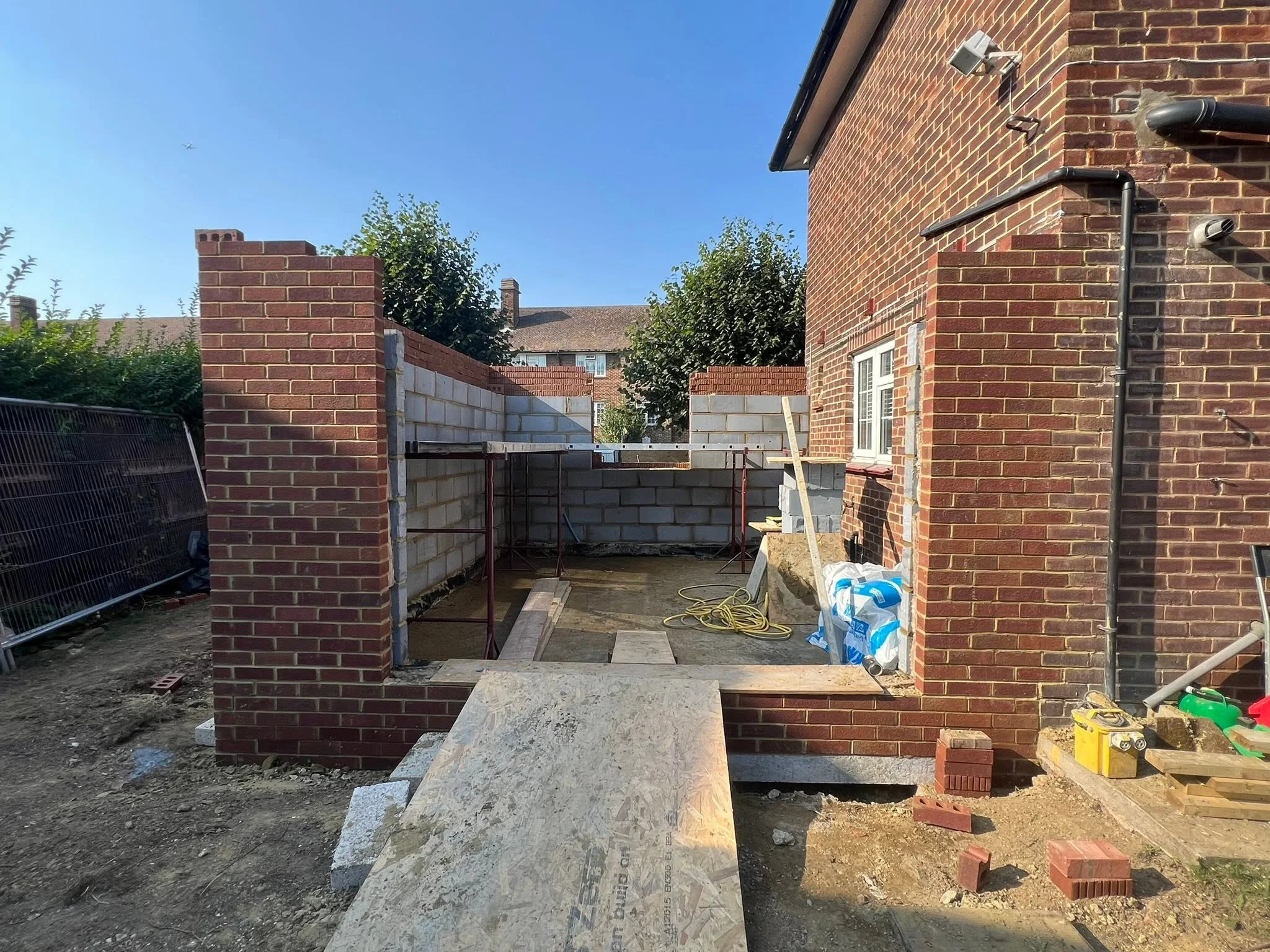
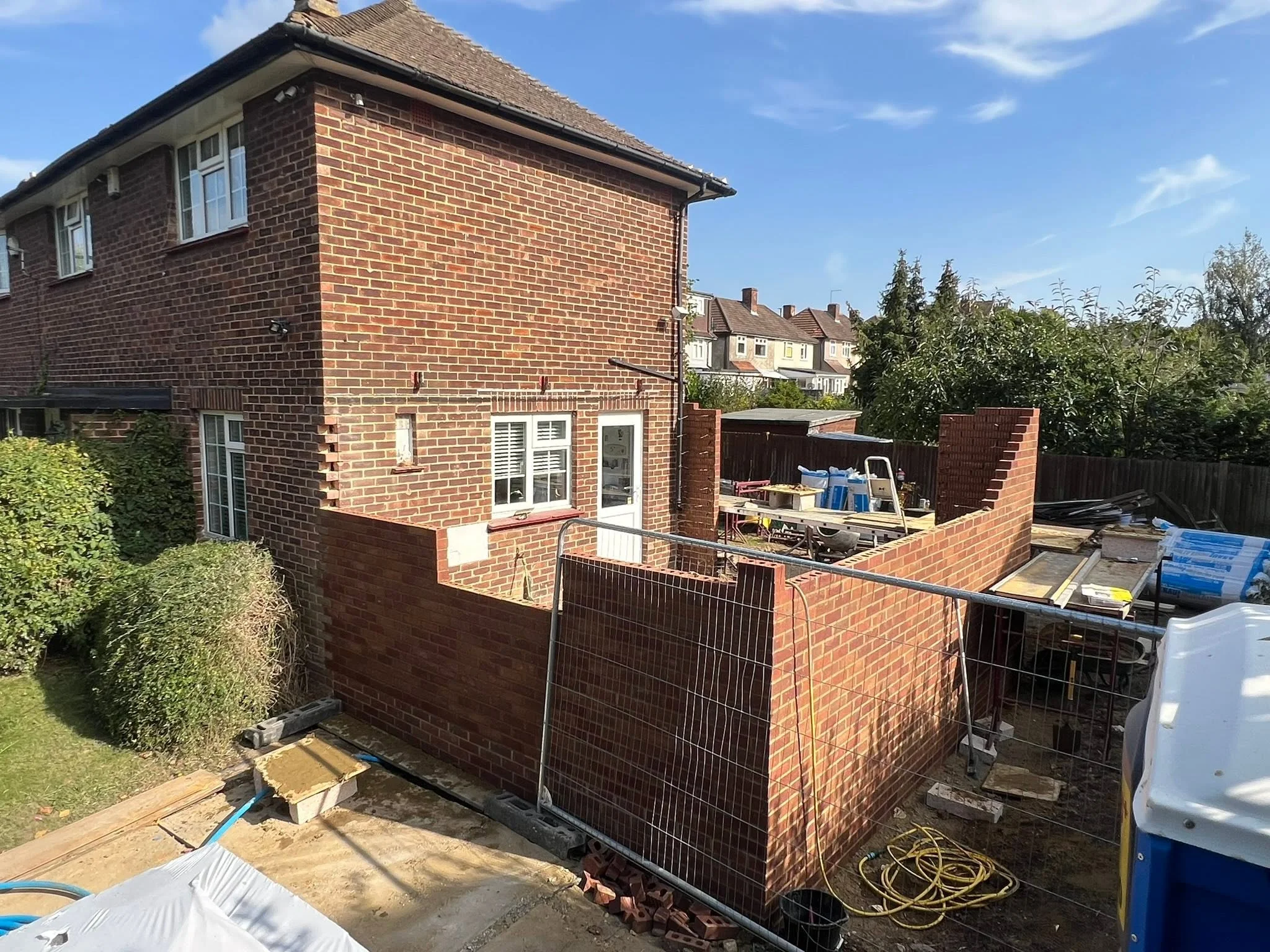
The exact same ground-first mentality applies to the rest of the garden. If you are planning single storey rear extension groundworks kent wide, getting a single team to handle the footing excavation, underground foul and surface water drainage, concrete oversite slab, and the superstructure brickwork up to roof plate saves weeks of finger-pointing between separate groundworkers and bricklayers.
And if you are tidying up the boundaries or installing a low-maintenance lawn for the kids and dogs:
- For concrete fence posts and garden fencing kent wide—especially on windy hilltops around the North Downs or coastal plots in Folkestone, Dover, and Thanet—we sink slotted concrete posts deep in post-mix or concrete and pair them with heavy-duty gravel boards and feather-edge closeboard panels so winter gales don’t flatten your boundary.
- For pet friendly artificial grass on free draining base installations over boggy Kent clay, we never lay turf over sand on top of mud. We strip the sod, lay a weed membrane, compact a proper crushed limestone and granite dust sub-base, and secure the perimeter on treated timber or composite edging so it drains fast and stays flat for years.
Need Honest Advice on a Brickwork, Patio, or Driveway Job in Kent?
If you have a garden wall that is starting to lean, a patio project you want laid properly on a full bed, or an extension or driveway that needs solid groundworks underneath, we are always happy to come out and take a proper look.
Based in Rochester, we cover all of Medway, Maidstone, Gravesham, Dartford, Tonbridge & Malling, Sevenoaks, Tunbridge Wells, Swale, Canterbury, Ashford, Folkestone & Hythe, Dover, and Thanet. We don't employ pushy salespeople—you will meet an experienced builder who will check your ground levels, check your DPC height and drainage runs, answer your questions straight, and send over a clear, itemised written quote.
Get in touch with Truly Brickwork & Construction today or call us on 07443118228 to book a free, no-obligation site visit anywhere in Kent.